






🎬 Video: Face-smasher #3
In this third episode of the series “Casse de figure” (Face-smasher), Master Chuck Maurice, accompanied by his faithful cousin Bruce, continues to teach French vocabulary related to violent situations and physical confrontations through a completely implausible scene.
It all begins in a forest in the dead of night. After a night of heavy drinking, Bruce pulls over in his pick-up to relieve himself. Just as he thinks he is alone in the darkness, mysterious interference suddenly disrupts his radio and the lights on his vehicle.
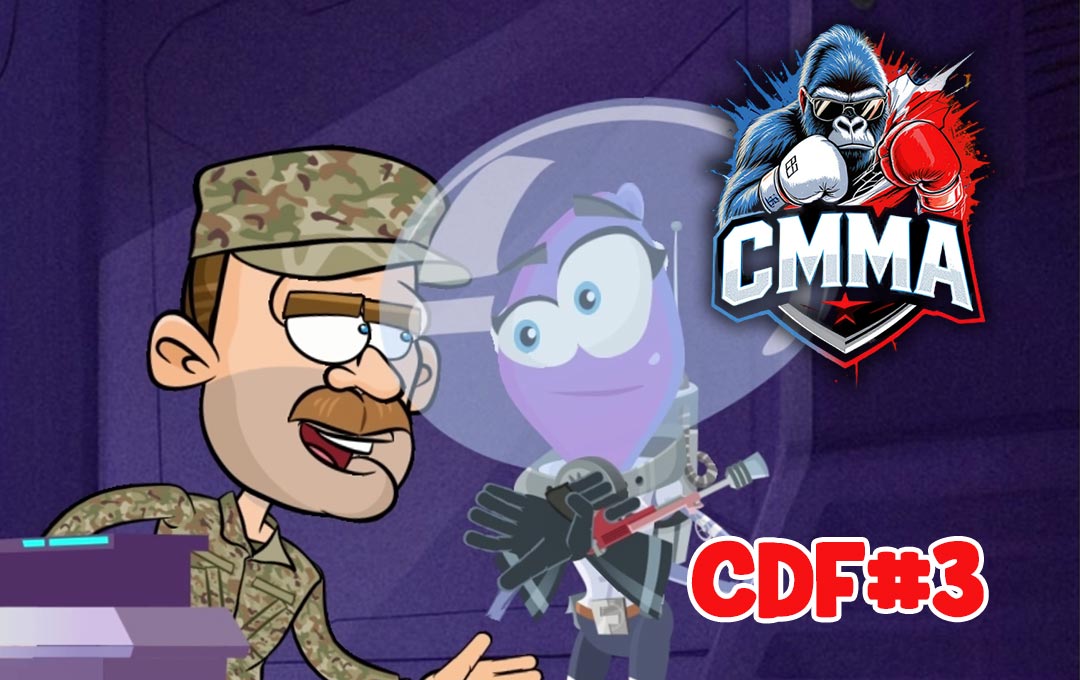
A beam of light appears from the sky: Bruce is abducted by a flying saucer and teleported aboard an alien spacecraft. Faced with an alien who announces her intention to dissect his brain to study human intelligence, Bruce immediately decides to fight back.
The situation escalates into a fight: Bruce tries to lunge at the alien to strangle it, but she responds with a powerful kick that sends him flying backwards… before he is violently hurled out of the ship.
As always, Chuck Maurice then analyses the scene in detail to explain the various stages of this intergalactic skirmish and introduce several French expressions relating to the abduction, the attack and the escape.
📚 Today’s vocabulary: expressions relating to violence
Kidnapper quelqu’un
Se faire kidnapper / se faire enlever
Riposter
Meaning
“Riposter” means to respond to an attack by attacking in return.
Example
Après l’attaque, il a immédiatement riposté.
Origin
The word comes from fencing terminology, where it refers to the act of responding immediately to an opponent’s attack.
English equivalent
to retaliate
to strike back
Meaning
“Kidnapper” someone means to abduct a person against their will and hold them captive, often with the aim of obtaining something (money, information, revenge, etc.).
an attack by an opponent.
Example
Les criminels ont tenté de kidnapper un riche homme d’affaires.
Origin
The word ‘kidnapper’ comes from the English ‘kidnap’, which is itself a combination of ‘kid’ (child) and ‘nap’ (to seize). The term originally referred to the abduction of children.
English equivalent
to kidnap someone
Meaning
These expressions mean to be the victim of a kidnapping.
“Se faire enlever” is often used in a slightly more neutral sense, whereas “se faire kidnapper” is a direct borrowing from English.
Example
Il s’est fait enlever en pleine rue.
Le personnage principal se fait kidnapper au début du film.
Origin
The expression “enlever quelqu’un” has been in use in French for a long time and literally means to take someone away by force.
English equivalent
to be kidnapped
to be abducted
Se jeter sur quelqu’un
Donner un coup de pied à quelqu’un
Asséner un coup
Meaning
The expression “se jeter sur quelqu’un” means to attack someone suddenly by rushing at them.
Example
Le chien s’est jeté sur le voleur.
Origin
The expression is based on the image of someone physically lunging at another person to attack them.
English equivalent
to pounce on someone
to jump on someone
Meaning
Donner un coup de pied signifie frapper quelqu’un avec son pied.
Example
Il lui a donné un coup de pied pour se défendre.
Origin
This expression simply refers to the physical act of kicking with the leg or foot.
English equivalent
to kick someone
Meaning
Asséner un coup signifie porter un coup violent ou puissant à quelqu’un.
Example
Le boxeur a asséné un coup décisif à son adversaire.
Origin
The verb ‘asséner’ comes from the Latin ‘asinare’, which means ‘to strike hard’.
English equivalent
to strike a blow
to deliver a powerful hit
Projeter quelqu’un en arrière
Prendre la fuite
Projeter quelqu’un en arrière / être propulsé en arrière
Meaning
These expressions describe a situation where a person is violently pushed or sent flying backwards as a result of a collision or a blow.
Example
L’explosion l’a projeté en arrière.
Il a été propulsé contre le mur.
Origin
The verb ‘projeter’ comes from the Latin ‘proicere’, which means ‘to throw forward’ or ‘to expel’.
English equivalent
to throw someone backwards
to be thrown backwards
Meaning
The expression “prendre la fuite” means to escape quickly to avoid a dangerous situation or a confrontation.
Example
Après l’attaque, le voleur a pris la fuite.
Origin
The expression is based on the idea of running away to escape danger.
English equivalent
to flee
to run away
✅ Why this video is useful for learning French
This episode helps learners pick up vocabulary that is very common in films, TV series and action stories, particularly words used to describe a kidnapping, an attack or a getaway. Thanks to the humorous and absurd tone of the series *Chuck Maurice Maître Affineur*, learners can memorise these expressions more easily and discover how they are used in dynamic narrative contexts.