







🐴 Julie’s Adventures | Learn French
Julie, the young apprentice of Chef Fernand, the King’s cook, travels across France in search of the ingredients needed to prepare 13 regional dishes for the King’s banquet.
In honor of a visit by a foreign dignitary, the King of France is hosting a banquet. He has tasked his chef with preparing the finest traditional dishes from France’s 13 metropolitan regions. The chef calls on his apprentice, the young Julie, to travel across the country to gather the ingredients needed to create these exquisite dishes.
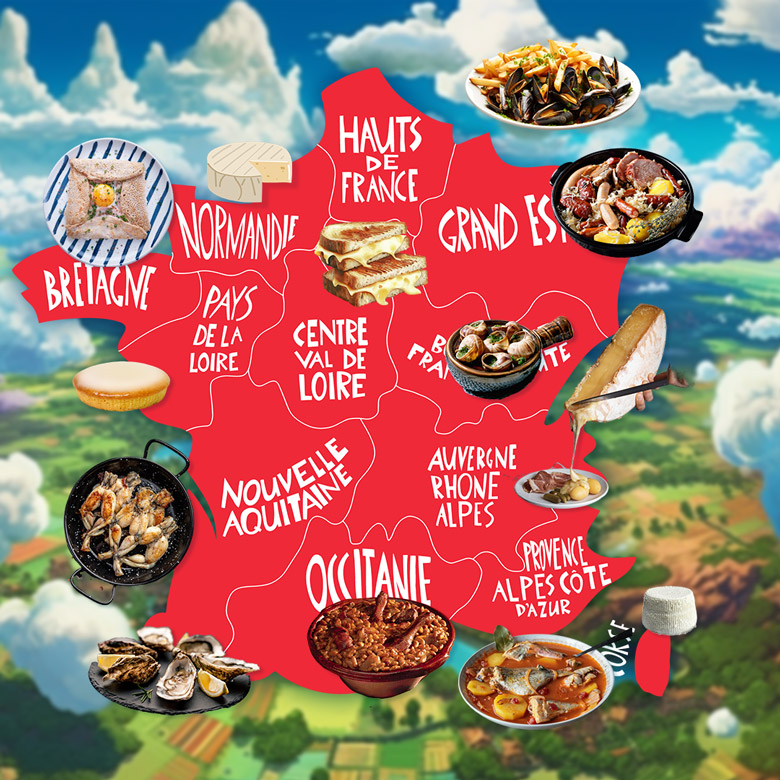
🖼 13 specialties from 13 French regions
01 – Île-de-France: croque-monsieur
02 – Grand Est: sauerkraut
03 – Hauts-de-France: mussels and fries
04 – Normandy: Camembert and cider
05 – Brittany: galettes
06 – Pays de la Loire: Gâteau Nantais
07 – Centre-Val de Loire: frog legs
08 – Burgundy-Franche-Comté: Burgundy snails
09 – Auvergne-Rhône-Alpes: raclette
10 – Nouvelle-Aquitaine: Marennes-Oléron oysters
11 – Occitanie: cassoulet
12 – Provence-Alpes-Côte d’Azur: bouillabaisse
13 – Corsica: brocciu
Croque-monsieur
The Croque-monsieur is a famous hot sandwich that first appeared in Paris in the early 20th century and is often associated with the city’s cafés and brasseries. It traditionally consists of white sandwich bread, ham, and cheese—usually Emmental or Gruyère—all toasted in the oven or in a skillet. In the classic version, a béchamel sauce is added inside or on top to provide creaminess and a golden crust. Its name is said to come from the verb “croquer” (to bite into) and “monsieur,” a term referring to a customer in Parisian cafés. There are several variations, including the Croque-Madame, topped with a fried egg.
Choucroute alsacienne
Choucroute garnie is one of Alsace’s most iconic dishes. It is made from finely shredded and fermented white cabbage, an ancient preservation method that gives it its slightly tangy flavor. The cabbage is then simmered for a long time, often with white wine or beer, and served with a generous assortment of charcuterie: sausages, smoked bacon, ham hock, or pork shoulder. Originally from Central Europe, sauerkraut became popular in Alsace thanks to cultural and commercial exchanges along the Rhine. This hearty dish is often served with potatoes and an Alsatian white wine.
Moules Frites
Mussels and fries are a popular specialty of northern France and neighboring Belgium. The dish combines fresh mussels cooked in a pot with herbs and spices (shallots, parsley, and sometimes white wine or cream) and crispy fries. Mussels are often prepared “marinière” style, but there are many variations depending on the restaurant. Highly popular along the North Sea coast, particularly during the Lille Braderie, this simple and hearty dish embodies the conviviality of Northern cuisine.
Camembert et cidre de Normandie
Normandy is renowned for its dairy products and orchards. Camembert de Normandie is a soft cheese with a bloomy rind made from raw cow’s milk, aged for several weeks to develop a creamy texture and a rich flavor. It is said to have been created in the late 18th century in the village of Camembert. The region also produces cider, a beverage made by fermenting apple juice. Together, these two products symbolize Norman cuisine, often served with rustic bread or used in various recipes.
Galettes bretonnes
Breton galettes, also known as buckwheat galettes, are savory pancakes typical of Brittany. They are made with buckwheat flour, water, and salt, then cooked on a large griddle called a billig. Their slightly nutty flavor pairs well with a variety of fillings: ham, cheese, egg, or vegetables. The most famous version is the “complète,” topped with ham, cheese, and egg. Traditionally, it is enjoyed with Breton cider, in crêperies or at local festivals.
Gâteau nantais
The Nantes cake is a sweet speciality from the city of Nantes. It is known for its moist texture and intense aroma of rum and almonds. The recipe combines butter, sugar, ground almonds, eggs and plain flour; the cake is then soaked in a rum syrup before being covered with a white icing. This pastry is said to have originated in the 19th century, at a time when Nantes was a major port trading with the West Indies, which explains the use of rum in the recipe.
Translated with DeepL.com (free version)
Cuisses de grenouilles
Frogs’ legs are a traditional speciality in several regions of France, including the Centre-Val de Loire. The legs are usually pan-fried in butter with garlic and parsley, giving them a delicate flavour often compared to that of chicken or fish. Historically, this dish was eaten in areas rich in ponds and rivers. Today, frogs’ legs are considered a gourmet dish, often served as a starter in traditional restaurants.
Translated with DeepL.com (free version)
Escargots de Bourgogne
Burgundy snails are one of the most famous specialities of Burgundian cuisine. The snails are cooked and then served in their shells with a parsley butter made from butter, garlic and parsley. This dish dates back to the 19th century, when a chef from Dijon popularised this preparation among gourmets. The snails used are often of the species Helix pomatia, also known as the ‘Burgundy snail’.
Raclette savoyarde
Raclette is a convivial dish originating from the Alpine regions. Its name comes from the verb ‘racler’ (to scrape), as in the past a wheel of cheese was melted over a fire before the melted part was scraped onto a plate. Nowadays, raclette is prepared using an electric appliance that melts the cheese in small pans. It is served with potatoes, cold meats and gherkins, and is a typical meal for winter evenings.
Huîtres Marennes Oléron
Marennes-Oléron oysters come from the oyster-farming area between Marennes-Oléron and the Île d’Oléron. They are farmed and then matured in tanks known as ‘claires’, which give them a distinctive flavour and sometimes a slightly greenish hue. They are often eaten raw with a squeeze of lemon or shallot vinegar, particularly during the festive season.
Cassoulet
Cassoulet is a rich, slow-cooked stew originating from south-west France. It is made with white beans, pork, duck confit and sometimes sausages. Its name comes from the cassole, a terracotta dish in which it is traditionally cooked. Several towns claim to have their own version: Castelnaudary, Toulouse and Carcassonne.
Bouillabaisse
Bouillabaisse is a fish soup that originated in Marseille. Fishermen used to use unsold or less desirable fish to prepare this fragrant dish. Bouillabaisse combines several Mediterranean fish (scorpionfish, conger eel, gurnard), cooked in a broth flavoured with saffron, fennel and tomato. It is traditionally served with croutons and rouille, a garlic and chilli sauce.
Fromage brocciu corse
Brocciu is a cheese synonymous with Corsica, made from sheep’s or goat’s whey. It has a fresh, slightly grainy texture, similar to ricotta. Brocciu is used in many Corsican recipes, both savoury (omelettes, cannelloni with brocciu) and sweet, notably in the famous Fiadone, a cheese and lemon cake.