






📖 Meaning of the expression “Comme un éléphant dans un magasin de porcelaine”
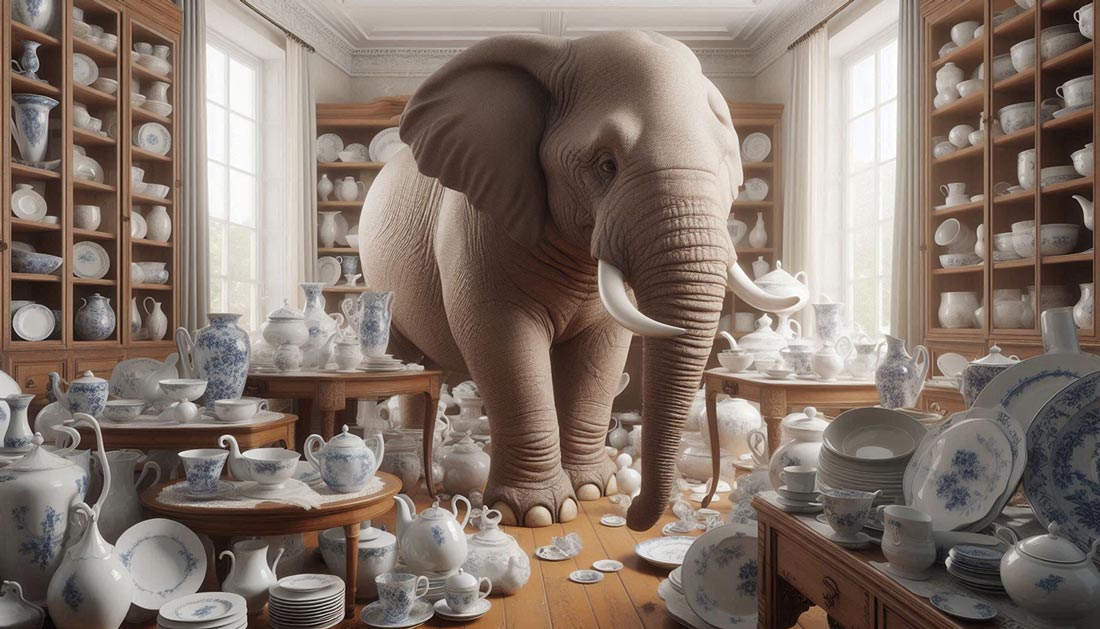
The expression “être (ou agir) comme un éléphant dans un magasin de porcelaine” means to be very clumsy in a delicate situation, or to act without care and risk causing damage or problems.
The image is easy to understand: an elephant is a very large and very heavy animal. In a shop full of fragile items such as porcelain, it would be likely to break everything.
This expression is therefore used to describe someone who lacks tact, sensitivity or discretion, particularly in delicate situations.
🕰️ Origin of the expression
The expression “comme un éléphant dans un magasin de porcelaine” is based on a highly visual metaphor that first appeared in Europe in the 19th century.
It is simply based on the idea that an animal as large as an elephant would inevitably cause damage in a room full of fragile objects.
In fact, a very similar expression can be found in several languages, which shows that this image is easily understood across different cultures.
Nowadays, this expression is used in everyday life as well as in the media, politics and the world of work.
💬 Examples of usage in French
Here are a few examples to help you understand how to use the expression “comme un éléphant dans un magasin de porcelaine”:
- Il a parlé de ce sujet très sensible comme un éléphant dans un magasin de porcelaine.
- Fais attention, tu agis comme un éléphant dans un magasin de porcelaine avec ces dossiers fragiles.
- Dans cette négociation diplomatique, il s’est comporté comme un éléphant dans un magasin de porcelaine.
This expression is often used to refer to a lack of tact or diplomacy, not just physical clumsiness.
🌍 English equivalent
The English equivalent of this expression is almost identical:
- like a bull in a china shop
Example:
- He walked into the meeting like a bull in a china shop.
➡️ Il est entré dans la réunion comme un éléphant dans un magasin de porcelaine.
Even if the animal changes (a bull in English, an elephant in French), the idea remains the same: someone acting brutally in a delicate situation.